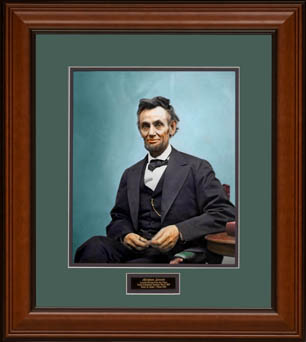
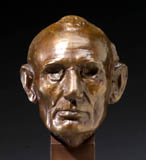
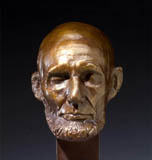
Abraham Lincoln Art Gallery. ComLincoln Store Lincoln Life Masks The Volk mask was taken live from Abraham Lincoln on March 31st, 1860 by Sculptor Leonard Volk at his Chicago studio. The bearded Mills mask was taken live from Abraham Lincoln on February 11th 1865 by Sculptor Clark Mills at the White House just two months before Lincoln's assassination. The castings and patina of these masks were made by sculptor James Nance and the photograph was made by Mel Schockner. The image size is 11.5 by 13.5 inches and is reproduced utilizing the expensive Giclee printing process on a high quality, archival, textured watercolor art paper. The framing uses archival acid free double matting and a beautiful walnut wood frame with an engraved plaque. The print is protected by a heavy conservation glass. Each print is signed and numbered by the artist. This framed print makes an excellent gift and will complement any home or office. |
|
Abraham Lincoln Presidential Art Gallery
American Presidential Original Art, Sculpture, Prints and more.
Abraham Lincoln Gallery
Abraham Lincoln Original Art
by Sculptor James J. Nance
Made In America
Framed Print of Lincoln Life Masks by Volk and Mills
For more detailed information on each of our products click the buttons below
Back to all products menu
Framed Prints of Abraham Lincoln Life Masks by Volk and MillsEdition Size1,000 limited edition prints, signed and numbered by artist.
DimensionsPrint Image Size - 11.5 inches wide by 13.5 inches high.Paper Size - 13.5 inches by 15.5 inches, counting one inch borderOutside Matt size 16 in by 20 inch.Outside Frame Width - 20.5 inches wide by 23 inches high
MattesAcid free archival quality heavy stockOuter Matt - 2.25 inches wide, blue green, white core with a fine weaveInner matt - 1/4 inch reveal, charcoal blue black core velvet textureThese are special order museum mattes which are unavailable in retail frame shops.
Print paperPrinted on a heavy, fine art, archive quality, lightly textured watercolor paper(Somerset Velvet Acid Free Paper)Satin FinishThis is the same high quality paper used in most artist limited edition painting prints.
Printing TechniquePrinted with the superior Giclee printing process.(Giclee, French noun pronounced "Zee Clay" meaning to spray or squirt. )
Limited Edition Fine Art Print of Lincoln Life Mask by Leonard VolkPrice $325
The Story Behind the Lincoln - Volk Mask.Sculptor Leonard Volk first met Abraham Lincoln in 1858 when Lincoln was debating Steven Douglass for the US Senate seat from Illinois. Douglass was Volk's brother in law as well as a patron and introduced him to Lincoln. During that first meeting, Volk, with the eye of an artist, could see the character in Lincoln's face and asked him to sit for a bust. Although Lincoln good naturedly agreed, it took two more years of insistence and perseverance by Volk to finally get Lincoln to sit. Eventually on March 31st 1860 shortly before Lincoln received the Republican nomination for president, Lincoln fulfilled his promise to Volk.The intention of the sitting was to sculpt a portrait bust and to this end, Lincoln made several trips to Volk's 5th floor Chicago studio. On the first visit, Volk took some measurements and made a mask so that he could continue to work on the bust between sittings. Volk used a poorly prepared thick plaster applied directly to Lincoln's face. Volk described the unfortunate results." It was about an hour before the mold was ready to be removed, and being all in one piece, with both ears perfectly taken, it clung hard, as the cheek bones were higher than the jaw at the lobe of the ear. He bent his head low and took hold of the mold, and gradually worked it off without breaking or injury; it hurt a little, as a few hairs of the tender temples pulled out with the plaster and made the eyes water." Lincoln who endured the ordeal in typical stoic humor later said that the process "was anything but agreeable."Despite the painful first sitting, Lincoln enjoyed the sessions as a opportunity to escape the hectic campaign. Volk reported that "He would talk unceasingly telling the funniest and most laughable of stories, but he talked little of politics or religion during those sittings." Lincoln was quoted as confiding "I am bored nearly every time I sit down to a public dining table by someone pitching into me on politics."The bust progressed quickly and Lincoln was impressed with Volk's effort. After a few sittings Lincoln looked at the bust and proclaimed "There is the animal himself." This was a compliment that Volk would cherish for his entire life. For the next weeks Volk continued to work on the bust and even sculpted a small cabinet sized replica. On May 18th, the day Lincoln received word of his nomination, Volk appeared at Lincoln's Springfield house with the completed cabinet bust as a present for Mrs. Lincoln. Lincoln was alone but happy and excited and greeted Volk warmly. They shook hands and Volk said, "I am the first man from Chicago, I believe, who has the honor of congratulating you on your nomination for President."Volk would create many fine Lincoln sculptures during his career, but he will be most remembered and appreciated by history for his remarkable mask of Lincoln captured at an historic moment. Through the years, almost every artist and painter attempting to capture Lincoln's elusive image has referenced Volk's mask. Lincoln's secretary John Hay later said of the Volk mask, "the face has a clean firm outline; it is free from fat, but the muscles are hard and full.; the large mobile mouth is ready to speak, to shout, or laugh; the bold curved nose is broad and substantial, with spreading nostrils; it is a face full of life, of energy, of vivid aspiration." It is indeed the face of the man who captured the country's favor and became our 16th president. The face of Abraham Lincoln.James J. NanceIncredible Photographs by Mel Schockner, Loveland ColoradoMore information on this Volk Lincoln life mask which we offer as a beautiful bronze casting mounted on a marble base
Limited Edition Fine Art Print of Lincoln Life Mask by Clark MillsPrice $325
|
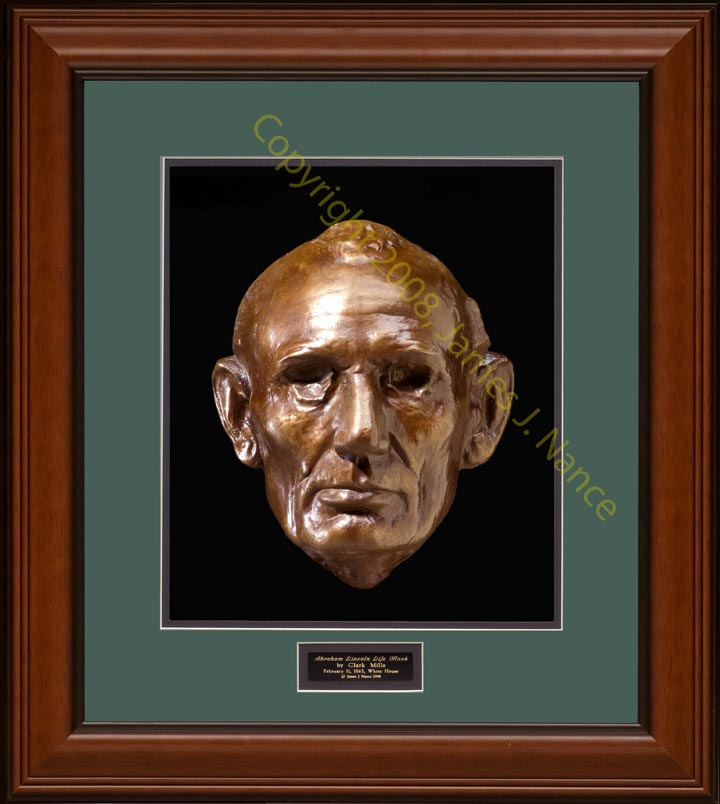
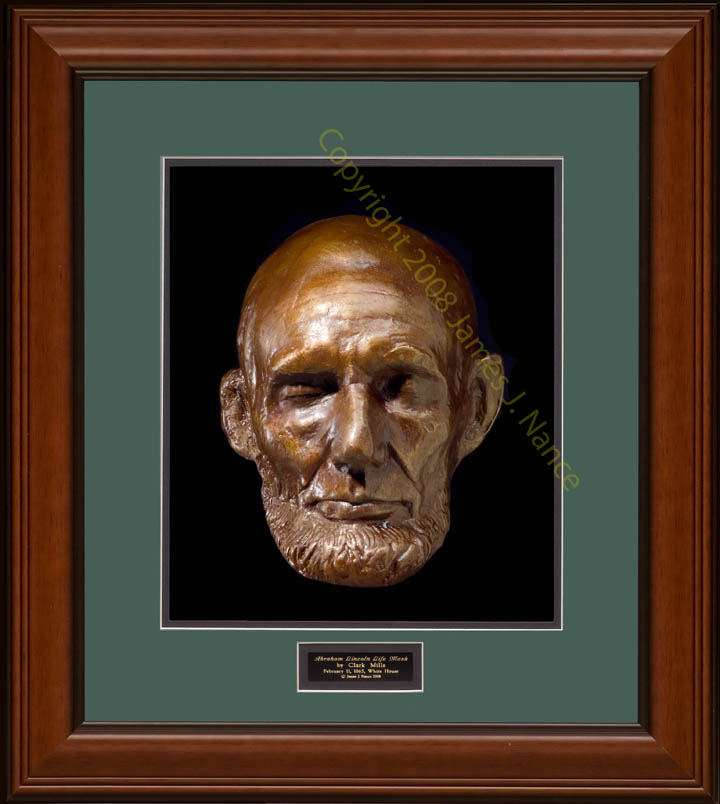
Abraham Lincoln Life Maskby Clark MillsFebruary 11th, 1865Copyright James J. Nance |
Abraham Lincoln Life Maskby Leonard VolkMarch 31st, 1860Copyright James J. Nance |
Print paper
Printed on a heavy, fine art, archive quality, lightly textured watercolor paper
(Somerset Velvet Acid Free Paper)
Satin Finish
This is the same high quality paper used in most artist limited edition painting prints.
Printing Technique
Printed with the superior Giclee printing process.
(Giclee, French noun pronounced "Zee Clay" meaning to spray or squirt. )
The Giclee printing process represents the highest technology available today and creates a museum quality print which is indistinguishable from the
original work of art. Unlike standard digital printing process, Giclee printing does not utilize small dots of pigment, which can create a grainy effect. A Giclee print utilizes highly accurate computer controlled jets to apply ink to various media from canvas to photographic paper. These jets vary the width of the ink stream to as small as 1/100 the width of a human hair yielding a photo perfect product with higher resolution than offset printing and a superior dynamic color range than serigraphy. A Giclee print is more expensive than other forms of photographic and digital printing techniques and if used on a archival paper will create a beautiful, archive quality print totally faithful to the original work. Most artist limited edition prints today are created with the Giclee process.
Traditional Use of Life Masks by Artists
In the preparation for a portrait commission, an artist will typically make a mask of the subject's face. Masks have been used for hundreds of years by sculptors and painters as stand ins for subjects who were unavailable. The early mask casting process required the subject to endure a long period of discomfort with burning plaster applied directly to the skin, although today modern materials have made this process much more pleasant and comfortable. Life masks were and still are a very useful reference tool which can guide the artist in proper proportion and skull structure when not in the presence of the subject. Occasionally a mask will take on a life of its own, transcend its original purpose as a reference tool, and become a treasured artifact. In our country's history, the three most famous masks are the Lincoln Volk, the Lincoln Mills, and the George Washington by Houdin. Both Volk and Mills are remember today not for the fine works of sculpture they each created, but for the Lincoln masks they made. Today we look at these masks and can sense the soul of Abraham Lincoln. The urge to touch them is irresistible.
Our Superior Quality Molds
Not all commercially produced masks of Lincoln are equal in quality. This inconsistency in quality is especially prevalent in the Volk mask made in 1860 and is caused by the limitations in mold material, the length of time (148 years) since the Volk mask was made, and the process used to produce new generations of molds. Over the years, the scenario was this: A mold was made of the mask and copies produced until the mold wore out. A careless caster then made a new mold from a copy cast from the old mold (frequently one of the final poor castings from an exhausted mold.) Too often a competitor would simply buy a commercial copy and make his own bootleg mold. Unfortunately, every time a mold is made, especially using older materials, small imperfections and distortions occur. The change may be imperceptible from one mold to another, but over 148 years and many generations of molds later huge distortions evolve. Contributing to these distortions is the property of plaster which causes minute shrinkage and distortion during curing. It is entirely likely that some of the Volk masks being sold today are the sorry product of hundreds of generations of molds producing progressively poor quality masks which have lost all detail and subtly.
What Makes Our Molds Different?
Our source molds were personally made by sculptor James Nance using a modern material (Silicone) which is distortion free and non shrinking. These molds were made in 1994 when he was researching the Lincoln image in preparation for the sculpting of his twin bronze Lincoln portrait busts located at the Lincoln home and Lincoln Library. The source of his molds were museum collection early originals from Volk and Mills. The Volk source was a first generation plaster from Leonard Volk and the source of the Mills mask was a first generation plaster cast which had been given by Mills to Lincoln's secretary John Hay. This access to first generation plasters has allowed Jim Nance to create second generation molds from which our masters were carefully cast using a stable material. These masters were then used to create our production molds. The masters will be used in the future to create new production molds when necessary and ensure continued quality.
Material of Our Masks.
Most commercial Lincoln Masks are made of unfinished plaster. Our masks are hand cast with a cold cast bronze which has the feel and look of and expensive foundry bronze. The process involves mixing a finely ground bronze powder in a resin matrix. The mixture has the look of a thick syrup and is poured into a mold. As the mold is slowly rotated, the mixture hardens. After removal from the mold the surface is polished with steel wool to reveal a finished surface of pure bronze. This bronze surface is then finished using the same techniques used on a foundry bronze casting. Our mask is indistinguishable from an expensive foundry bronze which would cost $2,000.
Mask Patina
Due to the illumination from photographic lights, sculptural patinas are very difficult to photograph. Since these castings have a bronze surface, the patina is hand applied using traditional bronze patina techniques. The color is a rich dark aged brown with a hint of red overlaying a golden undercoat. The brown patina is partially hand rubbed back to reveal varied and complex golden bronze highlights which are evident on raised areas contrasted by subtle shadows in recessed areas. The resulting patina is rich and traditional and will appearar different in different light settings. In a dark room the patina will appear dark and aged but under light the incredible golden brown patina will be revealed. Under direct sunlight or the photo flood lights used in these photographs, the finish will appear brighter and lighter than normal. To prevent tarnishing, the patina is sealed with a lacquer coating and buffed with bronze paste wax. Although the surface is durable, care should be exercised to avoid scratches with metallic objects. Polish the casting with a dry soft dust cloth and once or twice a year use a small amount of paste wax.
More information on these two life masks which we offer as beautiful bronze castings mounted on marble base
Abraham Lincoln Mask, Lincoln Mask, Abraham Lincoln Life Mask, Lincoln life Mask, Volk mask, Leonard Volk mask, Clark Mills Mask, Mills mask, Lincoln mask, Abraham Lincoln mask,
Abraham Lincoln Mask, Lincoln Mask, Abraham Lincoln Life Mask, Lincoln life Mask, Volk
sk, Leonard Volk mask, Clark Mills Mask,lls mask, Lincoln mask, Abraham Lincoln mask,
Abraham Lincoln Mask, Lincoln Mask, Abraham Lincoln Life Mask, Lincoln life Mask, Volk mask, Leon